
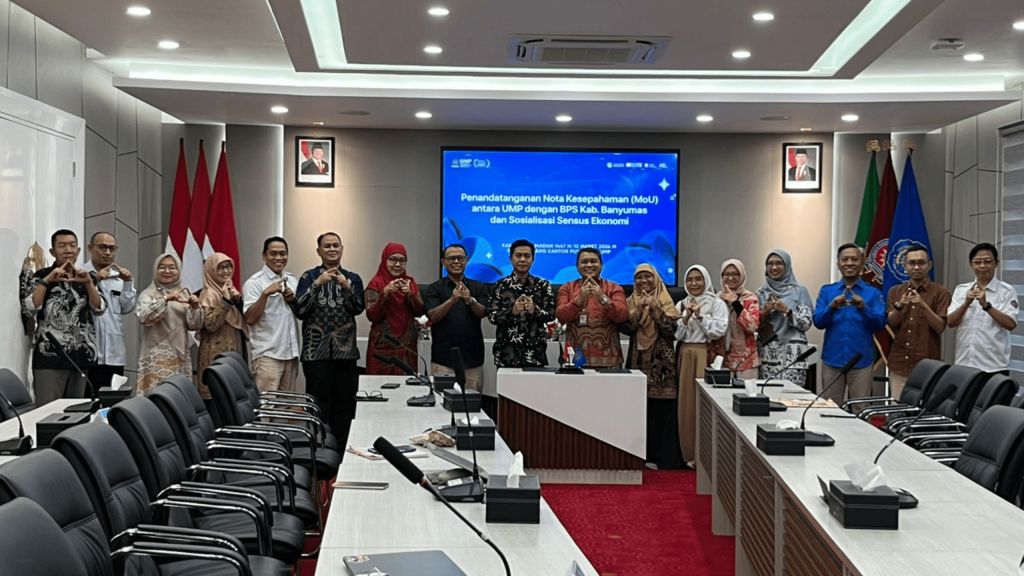
PURWOKERTO — A Memorandum of Understanding (MoU) was officially signed by Universitas Muhammadiyah Purwokerto (UMP) and the Central Bureau of Statistics (BPS) of Banyumas Regency on Thursday (March 12, 2026). This strategic collaboration is heavily focused on ensuring the successful execution of the 2026 Economic Census, while the utilization of statistical data is also being encouraged to strengthen the implementation of the Tri Dharma of Higher Education.
Full support for BPS programs is guaranteed to be provided by the university, as emphasized by UMP Rector, Prof. Dr. Jebul Suroso. Statistical data generated by BPS is considered vital and strategic by the academic institution, serving as a foundational pillar for both scientific research and community service initiatives.
It was stated by the Rector that a strong commitment to the success of the 2026 Economic Census is firmly held by the institution. Furthermore, it is believed by him that the collected data will be highly beneficial not only for developmental sectors such as economics and agriculture, but will also be immensely valuable for their educational purposes.
The massive potential of UMP’s human resources to synergize in data analysis was further highlighted by Prof. Jebul. Currently, an extensive academic force comprising approximately 470 lecturers and over 19,000 students across 11 faculties is housed by the campus.
It was firmly expressed by the Rector that if excellent data is possessed and contributions can be made, positive impacts can ultimately be delivered due to the data’s accuracy, especially when high-quality information is obtained from the Banyumas government.
Meanwhile, the partnership with the academic sector was enthusiastically welcomed by the Head of BPS Banyumas, Moh. Fatichuddin, S.Si., M.Eng. It is highly hoped by him that the vast array of BPS public releases—ranging from the Population and Agricultural Censuses to strategic sectoral data like poverty and inflation rates—can be optimally utilized by the thousands of students and hundreds of lecturers at UMP.
It was explained by Fatichuddin that great satisfaction would be felt if the data is widely utilized by the lecturers and students, as a vital control and validation mechanism is thereby created through the academic community’s active involvement.
It was additionally noted by Fatichuddin that the wealth of macro and sectoral data produced by BPS is frequently left unmaximized within university realms. Through this partnership, UMP is expected by BPS to serve as a strategic partner. It is hoped that the university will not merely be positioned as a data consumer, but rather as an active analytical body by which concrete, data-driven recommendations for the development of the Banyumas region can be provided.