
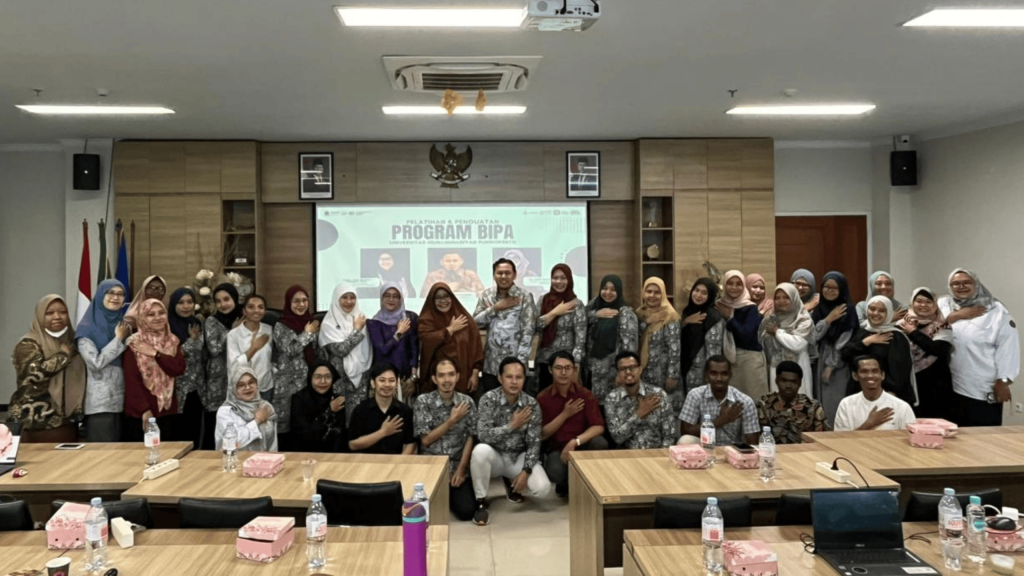
PURWOKERTO, Indonesia — Universitas Muhammadiyah Purwokerto (UMP), through its Bureau of Cooperation and International Affairs (BKUI), successfully hosted a two-day workshop on the Training and Strengthening of the Indonesian Language for Foreign Speakers (BIPA) program.
Held from Monday to Tuesday, January 26–27, 2026, the event was designed to elevate the competency of BIPA instructors and reinforce UMP’s strategic role in campus internationalization.
The workshop brought together Heads of Study Programs hosting international students, BIPA teachers, Language Development Center (LDC) instructors, and lecturers from across the university. The curriculum focused on equipping participants with the latest teaching methodologies to ensure sustainable quality improvements in the learning process.
Expert Insights and Practical Application
The event featured prominent speakers from both bureaucratic and practical teaching backgrounds. Dr. Brian Arieska Pranata, Director of SEAMEO QITEP in Language, opened the sessions by outlining various policies related to BIPA.
He was joined by Dr. Wati Istanti, M.Pd., Chair of the Central Java Association of BIPA Teachers and Activists (APPBIPA), who provided insights into the characteristics of learners from different countries and strategies for effective engagement.
On the second day, Assoc. Prof. Santhy Hawanti, Ph.D., a pioneer of UMP’s BIPA program, detailed the history of the program at the university and led practical teaching simulations for the participants.
Preparing for a Global Campus
Condro Nur Alim, Ph.D., Head of BKUI UMP, described the training as a critical step in preparing a competent workforce of BIPA educators.
“Through this workshop, we aim to ensure our BIPA teachers possess strong competencies, are capable of enhancing the learning process using the most cutting-edge methods, and involve all Study Programs at UMP,” Alim stated.
He further noted that the university envisions a future where every study program hosts international students. Consequently, cultivating a new generation of BIPA instructors who are ready to guide and support these students through their academic journey is essential.
A Collective Responsibility
Titik Wahyuningsih, S.S., M.Hum., Head of the UMP BIPA Program, emphasized that the success of the program relies on the entire academic community.
“We want to instill the understanding that the sustainability of this program is our collective responsibility, ensuring that foreign students receive optimal assistance through BIPA,” she said.
She added that the goal is for international students to not only speak Indonesian but to truly understand its context and usage. Through this initiative, UMP reaffirms its commitment to improving academic services for international students and strengthening the role of Indonesian as a global academic language.(shan)